
Paediatrics · Pediatrics
Too Fast to Count
A nine-week-old who feeds poorly and sweats has a regular tachycardia too fast for sinus rhythm. Recognise supraventricular tachycardia, decide between adenosine and synchronised cardioversion according to stability, and prevent heart failure.
How the case starts
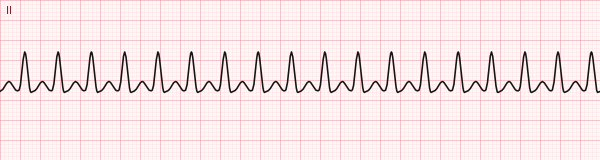
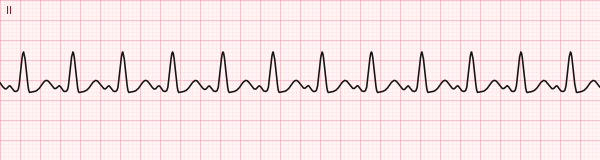
Nine-week-old boy, about five kilograms, brought in by his mother. Thirty hours of poor feeding, sweating with feeds, pale and breathing fast. On arrival the paramedic ECG showed a regular narrow complex tachycardia at about two hundred and twenty, saturations ninety-five percent on oxygen. No fever. Term birth, no known cardiac history. No IV access yet, no drugs given. The rate has been unchanged for the whole journey.
What the team practises
- Distinguish SVT from sinus tachycardia in an infant using rate, onset and variability.
- Choose between vagal manoeuvre, adenosine and synchronised cardioversion according to stability.
- Use adenosine correctly: a rapid push into a large proximal vein followed by a flush, with the defibrillator ready.
- Recognise heart failure from prolonged SVT and plan follow-up for pre-excitation.
On the monitor
The case moves through these rhythms on Ruqelo Sim's live monitor as the team works.
Running it in Ruqelo Sim
- The instructor picks the case and reads the handover; the monitor and the learner's screen join with a QR code
- The patient answers questions in their own words, and a resus nurse voice reads back every order
- The case moves on as the team acts, and every action is timed for the debrief
Similar cases
Run “Too Fast to Count” with your team
Ruqelo Sim runs the monitor, the instructor's controls and the patient on three iPads, tablets or computers, all in sync. From $19 a month, cancel any time.
 Also in the browser on any iPad, tablet or computer.